







Etnografie del contemporaneo: Donne, corpi, territori_n.4/2021
Fascia di prezzo: da 0,00€ a 16,00€
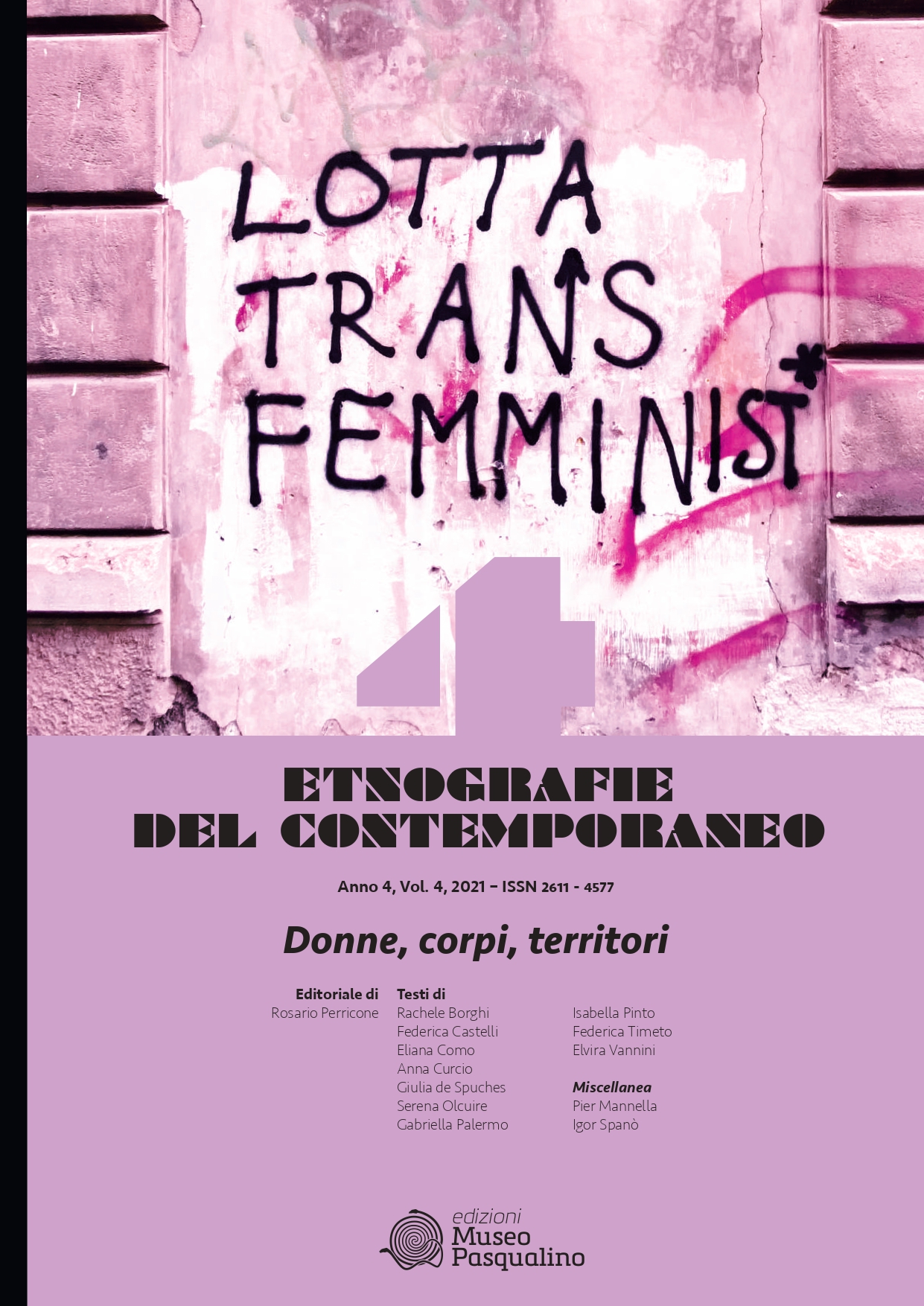
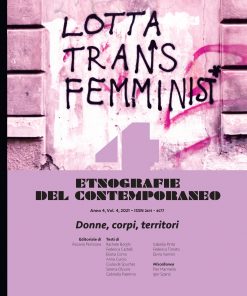
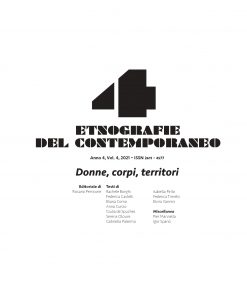
Etnografie del contemporaneo
Donne, corpi, territori
ANNO 4, VOLUME 4
Edizioni Museo Pasqualino, Palermo 2021
ISSN 2611 – 4577
_____________
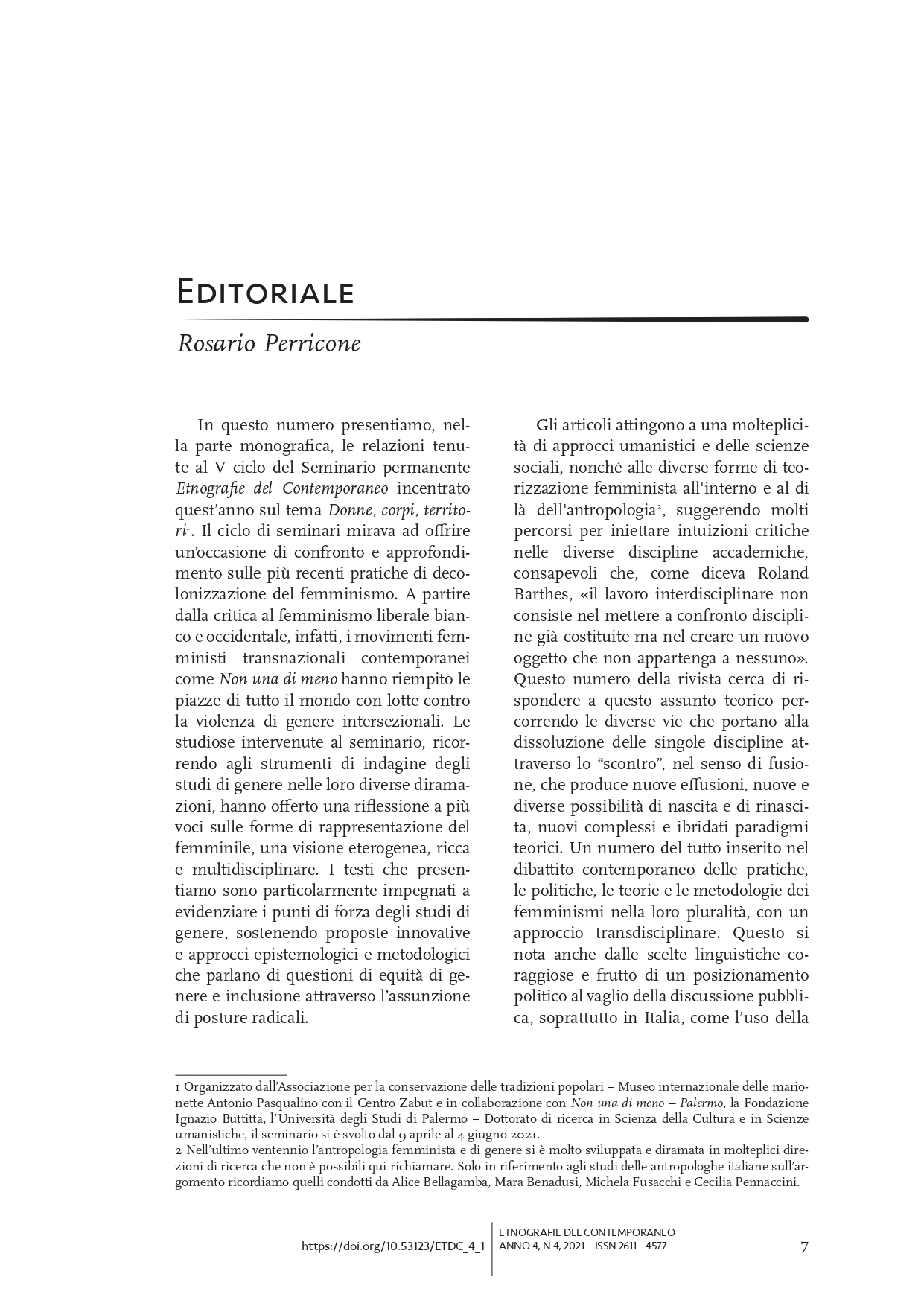
In questo numero presentiamo, nella parte monografica, le relazioni tenute al V ciclo del Seminario permanente Etnografie del Contemporaneo incentrato quest’anno sul tema Donne, corpi, territori.
Il ciclo di seminari mirava ad offrire un’occasione di confronto e approfondimento sulle più recenti pratiche di decolonizzazione del femminismo. A partire dalla critica al femminismo liberale bianco e occidentale, infatti, i movimenti femministi transnazionali contemporanei come Non una di meno hanno riempito le piazze di tutto il mondo con lotte contro la violenza di genere intersezionali. Le studiose intervenute al seminario, ricorrendo agli strumenti di indagine degli studi di genere nelle loro diverse diramazioni, hanno offerto una riflessione a più voci sulle forme di rappresentazione del femminile, una visione eterogenea, ricca e multidisciplinare. I testi che presentiamo sono particolarmente impegnati a evidenziare i punti di forza degli studi di genere, sostenendo proposte innovative e approcci epistemologici e metodologici che parlano di questioni di equità di genere e inclusione attraverso l’assunzione di posture radicali.
Un numero del tutto inserito nel dibattito contemporaneo delle pratiche, le politiche, le teorie e le metodologie dei femminismi nella loro pluralità, con un approccio transdisciplinare.
In questo numero:
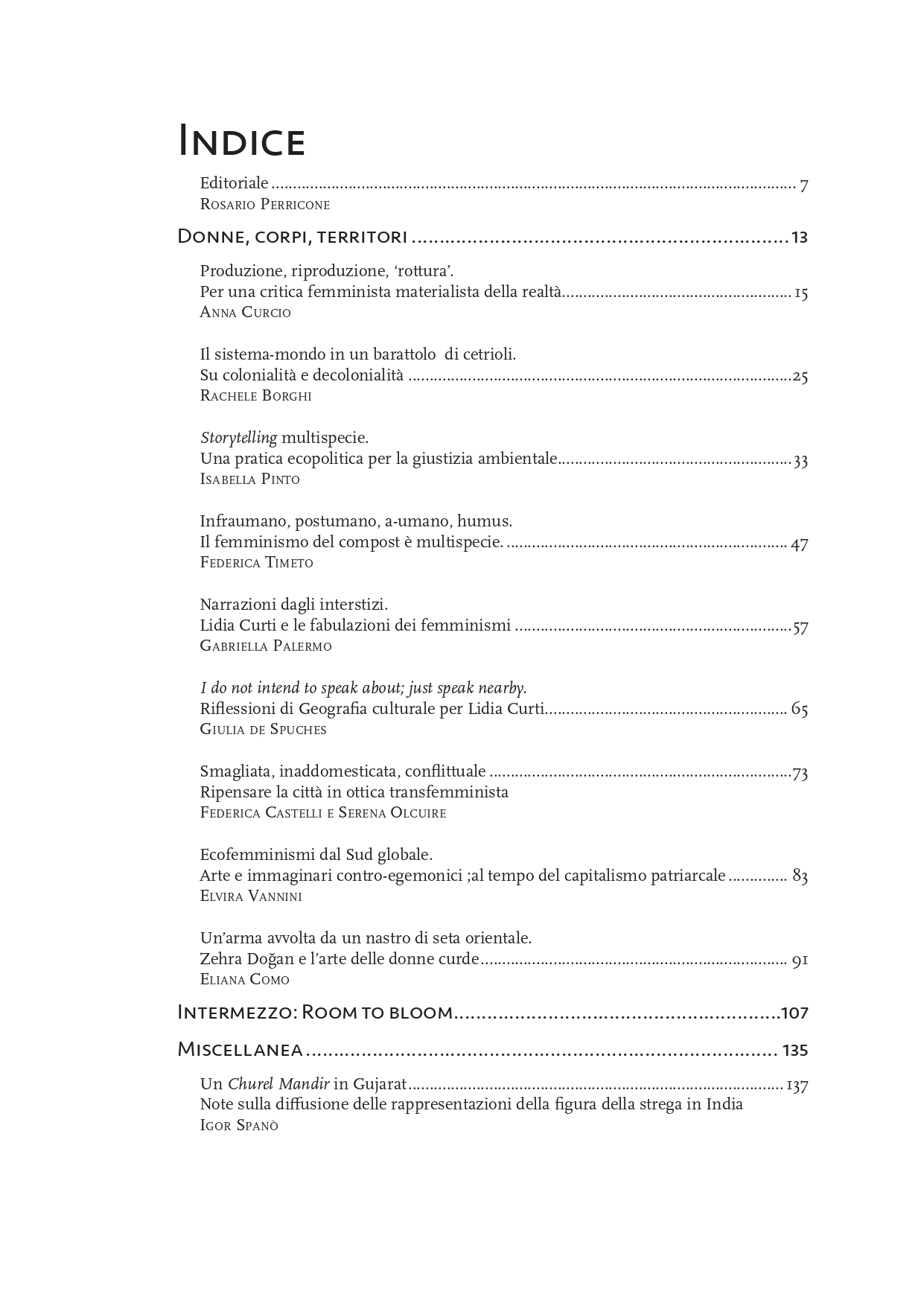
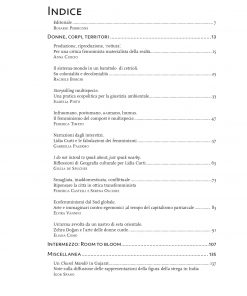
Editoriale
Rosario Perricone
DONNE, CORPI, TERRITORI
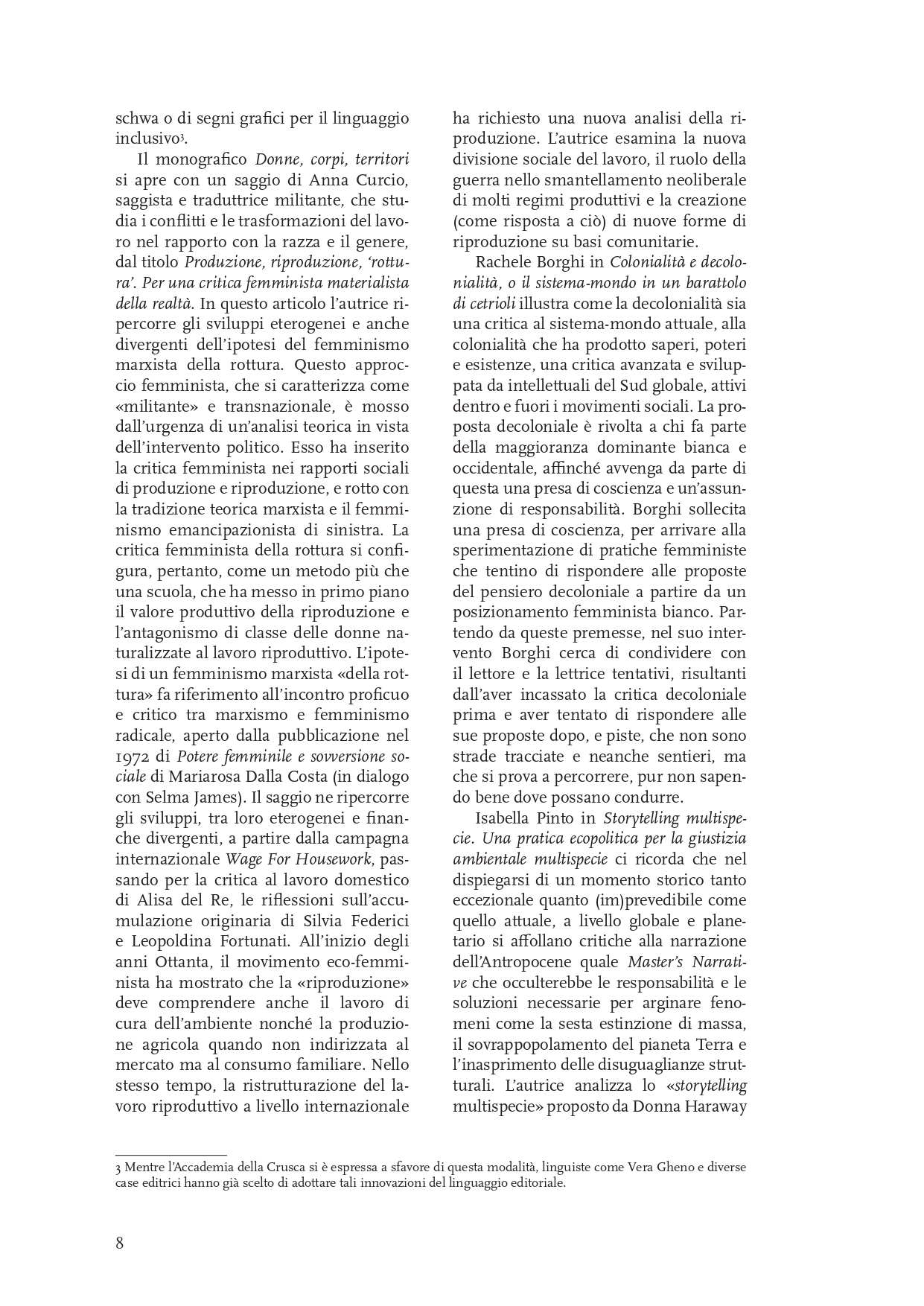
Produzione, riproduzione, ‘rottura’.
Per una critica femminista materialista della realtà
Anna Curcio
Abstract. In this article I retrace the heterogeneous and even divergent developments of the hypothesis of Marxist feminism of the rupture, a method rather than a school, that brought to the fore the productive value of reproduction and the class antagonism of women naturalised to reproductive labour. Finally, I try to produce some considerations about the topicality of these analyses, which, in spite of the profound transformations that affect the reproductive sphere and women’s work today, continue to offer useful interpretative keys.
Il sistema-mondo in un barattolo di cetrioli.
Su colonialità e decolonialità
Rachele Borghi
Abstract. Decoloniality is a critique of the world-system and a practice of breaking with coloniality that necessarily starts with an awareness of the oppressions one suffers and the privileges one enjoys. This awareness opens up two possible paths: being overwhelmed by the sense of vertigo brought about by the understanding of one’s own whiteness; or. In this article, I propose the themes of coloniality and privilege starting from the metaphor of the jar of gherkins as a system of power in which we are immersed; I then analyse the theme of decoloniality by exploring the terrain of or.
Storytelling multispecie.
Una pratica ecopolitica per la giustizia ambientale
Isabella Pinto
Abstract. The aim of the essay is to analyze the practice of “multispecies storytelling” proposed by Haraway (2016), to extrapolate tools for the creative critique of the narrative of the «Anthropocene» (Crtuzen, Stoemer 2000). The essay starts by deconstructing the dichotomous and patriarchal imaginaries linked to the “uncanny” (Freud 1919) and the “sublime” (Burke 1757; Kant 1790); subsequently, it shows how Haraway engages in composting alternative stories of technology and science, thanks to the adoption of the SF methodology; finally, it analyzes the speculative fabulation entitled The Camille Stories, to appreciate the troubling polyphony and polysemy of “multispecies realism” (Pinto 2021).
Infraumano, postumano, a-umano, humus.
Il femminismo del compost è multispecie.
Federica Timeto
Abstract. In this article I elaborate a partial genealogy that goes back to the theoretical roots of the animal question in relation to the crisis of Western Humanism and the boundary breakdowns separating the human from the non human. In order to show how it is possible to imagine and practice in very different ways what comes after the human, I reconnect the threads of Donna Haraway’s thought to highlight a continuity and a thickening of the animal question in her writings. I also intend to push it towards unexpected directions for a more radical politics that I propose here as multispecies feminism.
Narrazioni dagli interstizi.
Lidia Curti e le fabulazioni dei femminismi
Gabriella Palermo
Abstract. On 21 April 2021 Lidia Curti left us. One of the first to develop cultural and postcolonial studies in Italy, a central voice in feminist and gender studies, a tireless scholar, Lidia Curti was a fundamental figure for all of us. In this article, through three of her key texts, I retrace the leitmotiv of women’s writing of living ‘between’ the interstices in the light of Donna Haraway’s FS figurations, and the postcolonial and feminist method of the listening position and of ‘speaking nearby’ against the powers of ventriloquism.
I do not intend to speak about; just speak nearby.
Riflessioni di Geografia culturale per Lidia Curti
Giulia de Spuches
Abstract. This article introduces a reflection on personal journeys, of dialogues and readings, with Lidia Curti. What is feminine writing? And, what lies behind the screen of representation? These aim at highlighting their political and positional nature within a way of thinking inspired by geographical studies and the feminist thought. So, an attempt to create the bonds for a reflection on the meaning of writing and translation, and on the sense of identity and alterity is made through the voices of authors like Morrison, Devi, and Spivak. It is in the border writing of postcolonial authors that we find a ‘space of in-between’ that allows what has been removed – a testimony of the Mediterranean matter – to emerge.
Smagliata, inaddomesticata, conflittuale
Ripensare la città in ottica transfemminista
Federica Castelli e Serena Olcuire
Abstract. This contribution collects some reflections on the relationship between gender and urban spaces, starting from the disciplinary intersection between planning and philosophy and the encounter between thought and activism. In a historical context in which gender-oriented policies are more and more recurrent in the daily lexicon, a critical view is proposed which, starting from transfeminist posture and some of its collective practices in public space, questions its sometimes contradictory implications and proposes a shift from the paradigm of security to that of self-determination.
Ecofemminismi dal Sud globale.
Arte e immaginari contro-egemonici ;al tempo del capitalismo patriarcale
Elvira Vannini
Abstract. While the exaltation of a Eurocentric and patriarchal canon is evident today in the art history we have inherited, we have not yet managed to construct counter-histories or counter-hegemonic narratives. Feminism encounters the canon as a structure of exclusion, subordination and domination that marginalises minorities of gender and race. The text intends to analyse and recompose the positional geographies of the relationship between art and ecofeminism, at different latitudes and historical temporalities, with particular attention to the so-called Global South, from an anti-colonial point of view and as a critique of racial capitalism through the aesthetic paradigm.
Un’arma avvolta da un nastro di seta orientale.
Zehra Doğan e l’arte delle donne curde
Eliana Como
Abstract. Zehra Doğan is a Kurdish artist arrested in 2016 by Erdoğan’s regime for a drawing. Locked up in prison for over two years, when they took away her paints and papers she continued to draw and paint with what she found: coffee, tea, food remains, hair, even menstrual blood and urine. Her works mainly depict women challenging the regime and denouncing to Europe the oppression of the Kurdish people. In this article I analyse some of her main works; Zehra Doğan’s life and art are also a starting point to talk about feminist art and the role of women in art history.
Un Churel Mandir in Gujarat
Note sulla diffusione delle rappresentazioni della figura della strega in India
Igor Spanò
Abstract. The churels are figures of the folk imagery of a vast area of South Asia. They, commonly identified as witches, are spirits of women, died during pregnancy or childbirth, who return to the world of the living, possessing them. Aim of this study is to provide an analysis of the representations of the churels and of the ambiguous climate that has been created around these figures in India in recent decades. A reflection on the power of the representations of the churels throughout history up to present-day India could be considered a key to penetrate the network of relationships that revolve around the power (śakti) manifested in the divine feminine.
Dalla carta al muro.
Graffiti e rituali nelle segrete dello Steri
Pier Luigi José Mannella
Abstract. The article traces, among the manuscript and printed books (many of which are forbidden by the librorum prohibitorum indexes) consulted, copied and reproduced by Sicilian nigromanti, testimonies attributable to some drawings, graffiti, writings left by prisoners on the walls of the prisons of Palermo’s Steri. The essay documents the esoteric mystical value of some graphic manifestations and of the note descensio ad Inferos portrayed in cells 2 and 3, ground floor, based on the analogical correspondence, produced by necromantic rituals, between graphic representation and request, need, i.e. desired outcome.
| Edizione | Copia fisica, Copia digitale gratuita |
|---|
Prodotti correlati
![AM#3 [IL MUSEO COLLABORATIVO: INCONTRO CON RUTH PHILLIPS] [SELVAGGI IN VETRINA] [ANTROPOLOGO E COMUNITA': LA STORIA DI UN CASO] [ETNOGRAFIA DEL PATRIMONIO: IL DIBATTITO CONTINUA] [ESTETICHE DELL'IBRIDO IN AFRICA] [DALLE REGIONI: BASILICATA, LOMBARDIA E PIEMONTE] [DIDATTICA MUSEALE IN PRATICA] [RICORDI DI TULLIO TENTORI E ROBERTO LEYDI] [NUOVE DAL MiBAC]](https://www.edizionimuseopasqualino.it/wp-content/uploads/2019/11/am-03-cop-247x296.jpg)
Editoriale La variabile DEA Intervista Incontro con Ruth Phillips Miscellanea 1. I primitivi e noi. Esposizioni, rappresentazioni e musei Sandra Puccini 2. Riflessioni dopo un sogno. Il Museo “Sa Domu de is ainas” Maria Gabriella Da Re Versus 1.Fabbricare alieni Berardino Palumbo 2.Dilemmi e compimenti Vito Lattanzi 3.Zoppicando, ma per andare dove? Pietro Clemente 4.Dalla [...]
![AM#10 [LE RELIQUIE DI ELVIS] [ANTROPOLOGIA E ARCHITETTURA: INTERVISTA A FRANCO LA CECLA] [ CATALOGAZIONE AL PIGORINI] [DALLE REGIONI: MUSEI ETNOGRAFICI IN FRIULI VENEZIA GIULIA] [OMAGGIO A ROUCH] [IN EVIDENZA:ANTROPOLOGIA E TERRITORIO] [MUSEO DEL PROGRESSO-COLLEZIONE GRAZIANO]](https://www.edizionimuseopasqualino.it/wp-content/uploads/2019/12/am-10-cop-247x296.jpg)
Editoriale Del buon uso del visualismo. La lezione di Jean Rouch Vincenzo Padiglione Intervista 1. Clemente/Padiglione e La Cecla Miscellanea 1. Le reliquie di Elvis culto impresa museografica Paola de Sanctis Ricciardone 2. La collezione e i suoi contesti. Un’esperienza di catalogazione al Pigorini Rosa Anna Di Lella Collezione/museo 1. Tra passione e storia: il Museo [...]
![AM#5 [ETNOLOGIA, MEMORIA E OBLIO] [INTERVISTA A GIAN LUIGI BRAVO] [ARTE ABORIGENA E MUSEI AUSTRALIANI] [BASILICATA ETNOGRAFICA IN MOSTRA] [ESPERIENZE DI ALTERITA' AL MUSEO] [ANTROPOLOGIA E TURISMO] [BRIGANTI ESPOSTI] [DALLE REGIONI: MOLISE E SICILIA] [DIDATTICA: UNA VALIGIA E UN LIBRO] [BENI DEA E MiBAC] [AMERICANISTA A BOLOGNA]](https://www.edizionimuseopasqualino.it/wp-content/uploads/2019/11/am-05-cop-247x296.jpg)
Editoriale ospite Luoghi di memoria, luoghi di oblio Intervista Vito Lattanzi e Gian Luigi Bravo Miscellanea 1.L’arte aborigena e le strategie del National Museum of Australia Giuseppina Prayer 2. Estraneo e Museo Gottfried Korff 3. Una mostra, una regione, una città Ferdinando Mirizzi Galleria 1. Museo del Brigantaggio di Itri (LT) Vincenzo Padiglione Didattica 1.Un museo [...]
![AM#6 [MUSEI AFRICANI IN PRIMO PIANO] [FORMARE MUSEOGRAFI] [INTERVISTA AL PRESIDENTE AFRICOM] [ARTE AFRICANA A TORINO: UNA MOSTRA DISCUSSA] [DALLE REGIONI: SICILIA] [MEZZADRIA IN MUSEO] [UN PROGETTO PER IL MUSEO GUATELLI] [TESORI DEL PERU'] [ECOMUSEI A CONVEGNO] [ARCHIVI: IL FONDO LEYDI DI ETNOMUSICOLOGIA]](https://www.edizionimuseopasqualino.it/wp-content/uploads/2019/11/am-06-cop-247x296.jpg)
Editoriale Ritorno al futuro Intervista 1.Carlo Orefice / Emanuela Rossi e quattro museografi angolani Monografica 1. Africa e museo A.C.A. 2. L’etnologia e i musei in Africa: siti archeologici, paesaggi culturali memorie orali Roberta Cafuri 3. Reinventing Africa: i musei africani e le sfide del XXI secolo Anna Maria Pecci (con un’intervista al presidente dell’AFRICOM) [...]
![AM#37-39 [ETNOGRAFIE DEL CONTEMPORANEO III: LE COMUNITA' PATRIMONIALI]](https://www.edizionimuseopasqualino.it/wp-content/uploads/2019/11/am-37-39-cop-247x296.jpg)
“Uscirne insieme”. Farsi comunità patrimoniale Vincenzo Padiglione e Alessandra Broccolini Communitas Pietro Clemente Esporsi Alessandro Simonicca Regime giuridico ad hoc? Simona Pinton e Lauso Zagato Afrocubanismi Elena Zapponi Aristocrazie Stefano Maltese Autorità Sandra Ferracuti Boghes Ignazio Macchiarella, Giuseppe Cidda, Franco Davoli, Manuelle Mureddu e Giovanni Pirisi Casa di Zela Emanuela Rossi Casentino Emanuela Rossi in dialogo con Andrea Rossi Cocullo Lia Giancristofaro Cullatori Katia Ballacchino Ecomuseale Alessandra Broccolini e [...]
![AM#17 [MISSIONE MUSEI DEA] [DOSSIER PATRIMONIO INTANGIBILE/TRADIZIONI] [ IL FUTURO DEI MUSEI ETNOGRAFICI: INTERVISTA A CUISENIER] [LA BIENNALE DELL'AFRICA ] [QUAI BRANLY SOTTO ESAME] [MUSEO DELLA COLTELLERIA DI MANIAGO] [ICOM INTERNAZIONALE: INTERVISTA A JALLA] [UN MUSEO MOLTO GIAPPONESE]](https://www.edizionimuseopasqualino.it/wp-content/uploads/2019/12/am-17-cop-247x296.jpg)
Editoriale Missione Musei DEA. Invito ad una compilazione ‘esogamica’ Vincenzo Padiglione Intervista Vito Lattanzi e Jean Cuisinier Patrimonio intangibile 1. I beni DEA e il “fare” le tradizioni Paolo Apolito 2. Documento di lavoro Comitato scientifico per la valorizzazione delle tradizioni italiane 3. Il ruolo dei musei Pietro Clemente 4. Dalla parte dei protagonisti Sandro Portelli Galleria 1.Il [...]

[IMMAGINI DELL’ARABO IN MOSTRA] [STANDARD DI QUALITA’ E MUSEI] [INTERVISTA A TULLIO TENTORI SUL MUSEO NAZIONALE DELLE ARTI E TRADIZIONI POPOLARI] [MUSEI E RICERCA ETNOLOGICA IN FRANCIA] [FORMARE CURATORI IN AFRICA] [UN ILLUSTRATORE FRANCESE E GIUSEPPE PITRE’] [ABRUZZO, SARDEGNA, EMILIA-ROMAGNA: PATRIMONI E MUSEI DEMOETNOANTROPOLOGICI] Editoriale Demo cosa? Intervista Lattanzi/Padiglione e Tullio Tentori Miscellanea 1. Formare [...]
Quale relazione tra archeologia e Art Brut? Il colloquio interdisciplinare prende avvio dal caso di Gaetano Moschella, contadino siciliano che nella seconda metà dell’Ottocento riesce a vendere le sue sculture come reperti antichi al Museo Archeologico di Palermo e al British Museum. La vicenda è riemersa recentemente dai depositi del museo grazie agli studi della [...]